
In USD 460 Hesston Public Schools, we believe technology can be a valuable instructional tool when it enhances learning, increases student engagement, and provides students with opportunities that would otherwise be difficult to provide. At the same time, we recognize the importance of balancing technology with strong fundamental instructional practice that emphasizes teacher to student and student to student interaction with grade level content.
During the 2025–26 spring semester, we examined how frequently students were using technology in classrooms. The data from all three buildings demonstrate that students spend the majority of their instructional time engaged in learning activities that do not involve a computer or other digital device.
School | Estimated Technology Use | Key Takeaway |
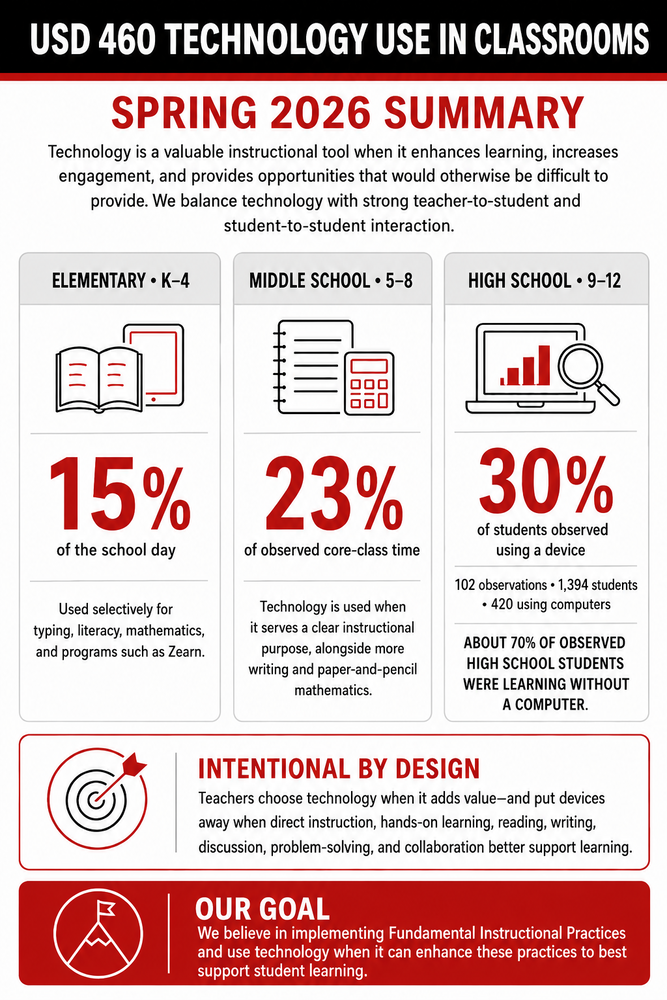
Elementary: K-4 | Approximately 15% of the school day | Technology is used selectively for foundational skills, including typing, literacy, mathematics, and programs such as Zearn. |
Secondary: 5-8 | Approximately 23% of observed core-class time | Teachers increasingly use technology only when it serves a clear instructional purpose, with a shift toward writing and paper-and-pencil mathematics practice. |
Secondary: 9-12 | Approximately 30% of students observed using a device | Across 102 classroom observations involving 1,394 students, about 30% of students were using a computer at any given time. |
Hesston Elementary School Summary
Elementary teachers estimate that students use technology for approximately 15% of the school day. Technology is primarily used to support foundational and essential skills, including typing, literacy, and mathematics practice.
Programs such as Zearn provide additional opportunities for students in grades 1–4 to practice mathematics skills. Teachers continue to intentionally balance these digital learning opportunities with direct instruction, hands-on learning, reading, writing, discussion, and other learning experiences.
Hesston Middle School Summary
During spring semester classroom walkthroughs, students were using devices approximately 23% of the time in core classes. Administrators and teachers have continued to discuss the importance of using technology only when it serves an intentional instructional purpose.
ELA teachers made a specific effort to reduce technology use while emphasizing the development of the writing process from 5th through 8th grade. Mathematics teachers have also shifted toward more paper-and-pencil practice for developing mathematical skills and concepts, while continuing to use technology selectively when it supports learning.
Hesston High School Summary
At the high school, administrators conducted 102 classroom observations between December 2025 and April 2026, observing 1,394 students across multiple classes and dates.
Of those students, 420 were using computers, representing 30.1% of students observed. Computer use ranged from 14% to 39% across observation periods, but remained consistently around 30% overall.
This means that, during the observed periods, approximately 70% of students were engaged in learning activities that did not involve a computer. As the school year progressed, several classrooms established protocols that intentionally reduced technology use during instruction and required students to use paper-and-pencil methods.
USD 460 Summary
Technology is present in our classrooms, but it is a small part of the teaching and learning experience. Our teachers are making increasingly intentional decisions about when technology adds value and when students are better served by putting the device away.
We will continue to evaluate technology use through classroom observations, teacher collaboration, and student learning data. Our goal is not to eliminate technology from classrooms or to use it simply because it is available. Our goal is to ensure that every instructional choice supports meaningful learning and high expectations for every student.
As we continue implementing our Fundamental Instructional Practices, we will remain focused on creating classrooms where students are actively thinking, communicating, reading, writing, problem-solving, collaborating, and engaging with their teachers and peers. When technology enhances that learning and supports our fundamentals, we will use it intentionally. When it does not, we will put it away.